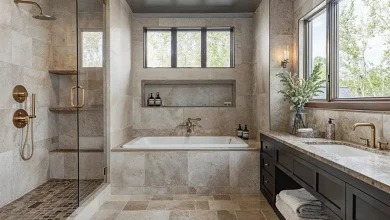
A residential bathroom functions essentially as an architectural pressure cooker. Every hot shower unleashes dense plumes of heated vapor that test perimeter caulking, condense against cool ceiling drywall, and search for unsealed paths into wall cavities. While an aesthetic upgrade with pristine marble and custom cabinetry looks breathtaking on day one, water is an unrelenting adversary. If finishes and substrates are selected purely for their surface appearance without accounting for porosity, vapor permeability, and thermal movement, the result is predictable: warped cabinetry, crumbling grout, bubbling paint, and hidden mold colonies that demand premature renovation.
Designing a bathroom capable of withstanding decades of daily use requires an intentional, layered approach to material selection. True durability is not achieved through a single waterproof surface; it relies on an integrated defense system that begins inside the wall framing and extends to the visible hardware. By understanding how different materials interact with liquid water and chronic humidity, you can build an interior that balances sophisticated design with lasting structural resilience.
Substrate Integrity: The Critical Layer Behind the Tile
The most disastrous bathroom failures rarely occur on the surface of the tile; they happen in the hidden layers underneath. A common misconception among homeowners is that ceramic tile and grout joints form an impermeable, waterproof barrier. In reality, standard cementitious grout and unglazed tile edges are porous, absorbing moisture and allowing water vapor to pass directly into the wall structure.
Relying on standard gypsum drywall—or even traditional water-resistant greenboard—inside high-exposure zones like showers and tub surrounds is a recipe for catastrophic moisture damage. Standard gypsum cores degrade into mush when subjected to prolonged moisture exposure, leading to loose tiles and rot along the wall studs.
Long-lasting installations demand specialized backer boards:
-
Extruded polystyrene (XPS) building boards: Modern foam-core backer panels, engineered with high-density waterproof foam reinforced with fiberglass mesh and cementitious coatings, have revolutionized wet-area construction. Because the core itself is completely impervious to water, these boards act as both a structural tile backer and a continuous waterproof membrane, eliminating the capillary water wicking common in older installations.
-
Fiber cement and cementitious backer units (CBU): Dense cement boards provide unyielding structural stability and will not soften or decompose when exposed to moisture. However, because cement board remains permeable to liquid transfer, it must be paired with a continuous topical liquid-applied or sheet-membrane waterproofing system before laying tile.
-
Glass-mat gypsum for perimeter dry zones: Outside the immediate shower footprint, where walls endure high ambient humidity rather than direct spray, fiberglass-faced gypsum panels provide superior resistance to mold growth compared to paper-faced drywall.
Flooring and Wall Surfaces: Porosity and Grout Dynamics
When specifying floor and wall coverings, the material’s water absorption rate dictates its long-term viability. Materials that readily absorb water will swell, stain, effloresce, or crack as structural temperatures cycle between hot showers and cool drafts.
Porcelain Versus Ceramic and Natural Stone
While glazed ceramic tile remains a budget-friendly staple, dense porcelain tile is the gold standard for wet environments. Manufactured from refined clays fired at extreme temperatures, porcelain features an impervious water absorption rate of less than 0.5 percent. This ultra-dense crystalline structure ensures that water cannot penetrate beneath the surface, preventing deep staining and frost-thaw fractures.
Natural stones such as marble, limestone, and travertine introduce organic warmth and timeless luxury, but they require significant protective discipline. These stones contain microscopic pores and mineral veins that absorb standing water, colored bath products, and acidic soaps. If you select natural stone, anticipate applying high-grade penetrating fluoropolymer sealers annually, and avoid installing soft, calcium-rich stones on high-traffic shower pans where moisture dwells.
The Superiority of Advanced Grout Formulations
Grout represents the weakest link in any tiled assembly. Standard cement-based grout behaves like a rigid sponge, drawing water deep into the joint network and harboring black mold inside its microscopic voids.
To ensure lasting protection, specify epoxy grout or high-performance pre-mixed urethane formulas. Epoxy grout contains zero cementitious material; it cures through a chemical reaction between epoxy resins and hardeners, resulting in an entirely non-porous, plasticized joint. It repels liquid instantly, resists harsh chemical cleansers, never requires sealing, and completely eliminates the efflorescence that frequently discolors traditional cement joints.
Cabinetry and Millwork: Resisting Swelling and Delamination
Bathroom vanities live in an unforgiving microclimate characterized by rapid humidity swings and occasional localized leaks around sink traps and supply lines. Specifying the wrong core wood product will ruin a custom vanity within a few short years.
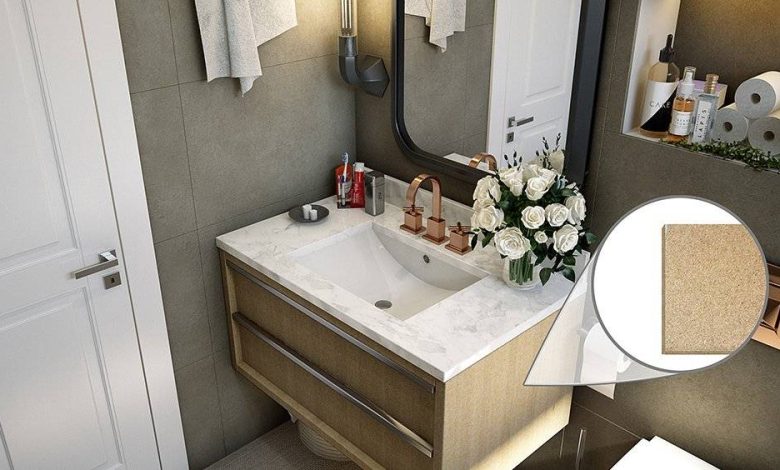
Avoid standard medium-density fiberboard (MDF) or raw particleboard cabinets. These engineered wood composites are composed of pulverized wood fibers bound with resin. The moment moisture breaches the thin melamine skin or edge banding, the underlying fibers expand rapidly, causing irreversible swelling, blistered veneers, and structural collapse.
Instead, invest in vanities constructed from marine-grade or multi-ply furniture-grade plywood. Plywood consists of alternating layers of solid wood veneer glued with the grain running in perpendicular directions. This cross-laminated construction distributes internal tension evenly, providing exceptional dimensional stability that resists warping, cupping, and swelling in humid environments.
For painted finishes, look for finishes cured with industrial polyurethane or catalyzed conversion varnishes rather than standard air-dried latex paint. If natural wood is preferred, choose naturally rot-resistant species like teak, white oak, or cedar, and ensure the fabricator applies water-resistant finishes to all concealed cabinet edges, including the underside and rear plumbing cutouts.
Coatings and Ceiling Protection
Ceilings endure the highest concentration of rising thermal vapor, making them prime territory for peeling paint and mildew spotting. Standard flat ceiling paints are formulated with porous binders that absorb steam, creating a hospitable breeding ground for fungal spores.
High-performance bathroom ceilings require specialized paint formulations:
-
Antimicrobial and mildewcide additives: Premium bathroom coatings incorporate active, non-leaching fungicides that actively inhibit fungal colonization on the paint film.
-
Sheen calibration: While ultra-flat paints hide drywall imperfections, they are too porous for wet areas. Opt for satin or eggshell sheens, which contain higher resin-to-pigment ratios. The tighter molecular surface film causes condensation to bead up and roll off rather than soaking into the drywall core.
-
Dedicated moisture-barrier primers: Always seal bare drywall or patched areas with a high-adhesion, 100-percent acrylic primer before applying topcoats to prevent uneven absorption and flashing.
The Mechanical Dimension: Ventilation Synergy
Even the most resilient architectural materials will eventually fail if ambient moisture remains trapped in the room for hours on end. Moisture resistance is not merely a passive property of materials; it is an active mechanical balance.
An undersized or neglected exhaust fan permits indoor relative humidity to hover above 70 percent, driving vapor deep into microscopic material voids through vapor pressure. Install an exhaust fan rated to deliver at least one CFM per square foot of floor space, adjusting upward for high ceilings or enclosed water closets.
Pairing the exhaust fan with a modern condensation sensor ensures the unit activates automatically the moment a shower starts and continues exhausting until the ambient humidity returns to baseline, removing human error from the moisture management equation entirely.
Choosing materials for a bathroom is an exercise in defensive design. By pairing impervious porcelain and waterproof structural backer boards with resilient plywood millwork and active mechanical ventilation, you build a space that effortlessly repels moisture, maintains pristine air quality, and preserves its design value for years to come.